

 Access
Economics: An Introduction to the Branches and Characteristics of the Discipline
Economics is a vital social science that helps us understand how individuals, businesses, and governments make choices in a world of limited resources. Every day, we face decisions about spending, saving, producing, and distributing goods and services. Economics provides the tools to analyze these decisions and their impact on society.
What Is Economics?
Economics is the study of how people allocate scarce resources to satisfy unlimited wants. It examines how choices are made, how markets function, and how policies affect economic outcomes at both individual and national levels. At its core, economics seeks to explain what is produced, how it is produced, and for whom it is produced.
Main Branches of Economics
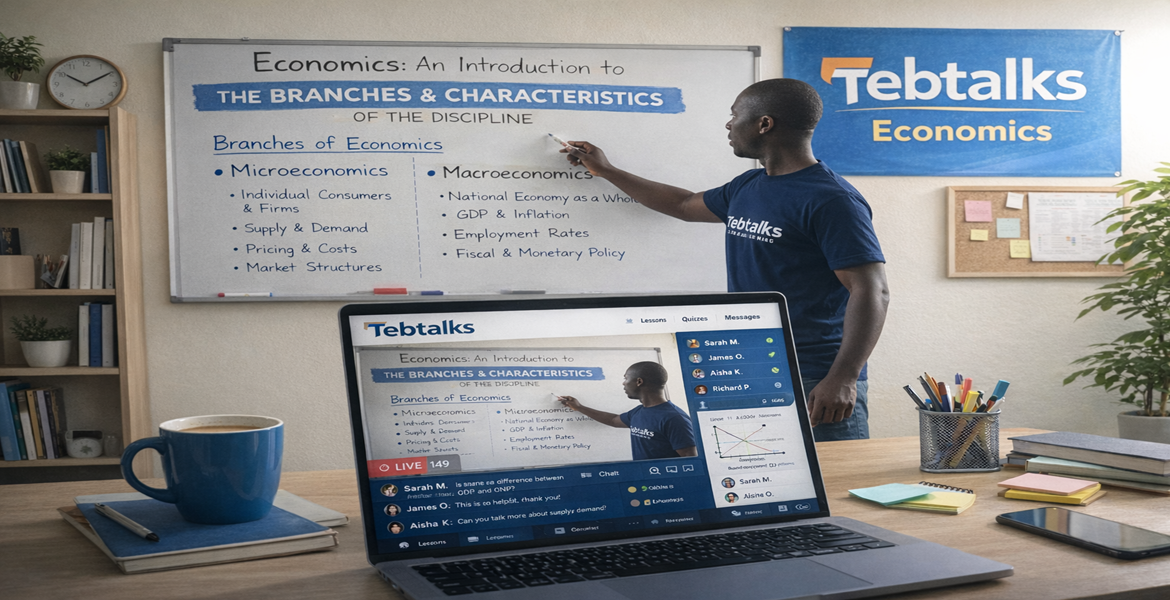
Economics is broadly divided into two main branches:
1. Microeconomics
Microeconomics focuses on individual units within the economy. It studies:
-
Consumers and their buying behavior
-
Firms and production decisions
-
Supply and demand
-
Pricing, costs, and profits
-
Market structures such as competition and monopoly
Microeconomics helps explain how prices are determined and how resources are allocated in specific markets.
2. Macroeconomics
Macroeconomics looks at the economy as a whole. It deals with:
-
National income and GDP
-
Inflation and unemployment
-
Economic growth and development
-
Fiscal and monetary policies
-
International trade and global economic relations
Macroeconomics helps governments and institutions design policies to stabilize and grow the economy.
Characteristics of Economics
Economics has several key characteristics that define the discipline:
-
Social Science: It studies human behavior in relation to scarce resources.
-
Choice-Oriented: It focuses on decision-making and trade-offs.
-
Dynamic: Economic conditions change over time due to technology, population, and policies.
-
Practical and Theoretical: Economics combines theories with real-world applications.
-
Policy-Relevant: It provides a foundation for government and business decision-making.
Why Economics Matters
Understanding economics empowers individuals to make informed financial decisions, helps businesses plan and grow, and enables governments to create effective policies. From managing personal budgets to addressing national unemployment and inflation, economics plays a critical role in everyday life.
Learn Economics with Tebtalks
At Tebtalks, economics is taught in a simple, practical, and engaging way. Learners gain not only theoretical knowledge but also real-world insights that can be applied in business, education, and daily decision-making.